
- June 30, 2026
- Posted by: admin
- Category: blog
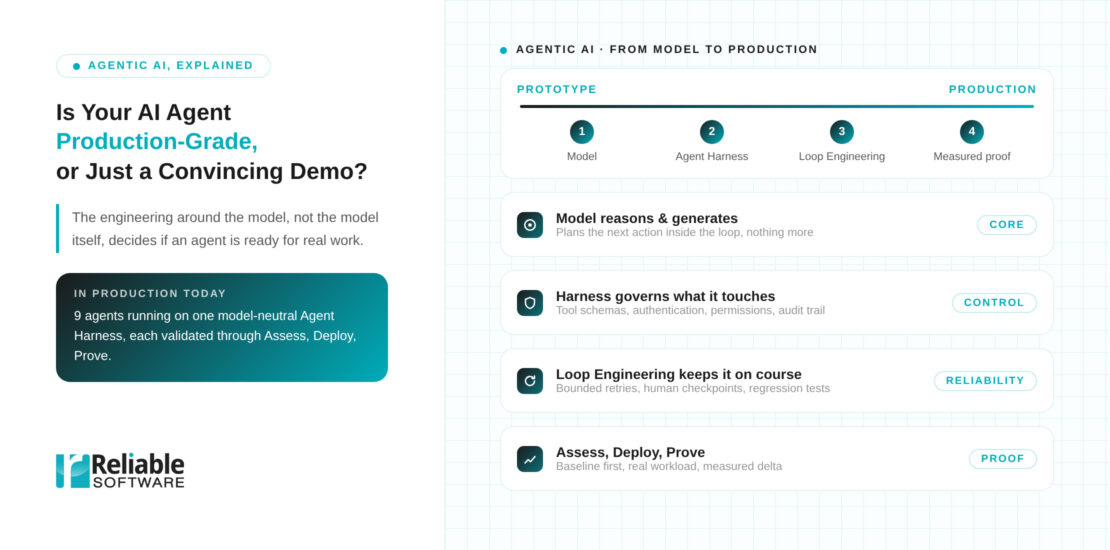
Agentic AI, Explained
Is Your AI Agent Production-Grade, or Just a Convincing Demo?
How harnesses and frameworks turn a model into a reliable system, and why the engineering around the model is what decides the answer.
"Agentic AI" gets used loosely enough that it's worth being precise about what it means technically, and why the engineering around a model, not the model itself, is what determines whether an agent is production-grade or a demo.
What makes a system "agentic"
A single LLM call is a function: input goes in, text comes out. An agent is a control loop wrapped around that function. It observes state, plans a sequence of actions, executes those actions against real tools or systems, evaluates the result, and decides whether to continue, retry, or stop.
That loop, usually described as plan, act, check, is what separates an agent from a chat interface. The model is the reasoning component inside the loop; it is not the system.
This matters technically because most of the failure modes people associate with "AI going wrong" aren't model failures. They're loop failures: an agent that takes an action without validating its inputs, that has no way to detect it's stuck in a retry cycle, or that has no checkpoint where a human can intervene before an irreversible action executes.
Why a model alone isn't a deployable system
A capable foundation model with no harness around it has three concrete gaps. None of them are solved by a bigger or newer model. They're solved by the layer that sits between the model and the world.
The Agent Harness: the integration and control layer
An Agent Harness is that layer. Architecturally, it's a model-neutral abstraction sitting between the reasoning component (the LLM) and everything the agent needs to act on: internal systems, data stores, external APIs, and the approved model endpoints themselves.
Model-neutral is a specific design choice, not a marketing term. It means the harness defines a stable interface (tool schemas, authentication, structured input/output contracts) that the model talks through, rather than being wired directly to one vendor's API.
Practically, that buys three things:
Model portability
Swapping or upgrading the model doesn't mean rebuilding integrations to case management, ticketing or document systems. The harness's contract with them stays the same.
Consistent guardrails
Access control, rate limits and permission scoping live in the harness, so what an agent may touch is enforced by code, not by hoping it follows a system prompt.
Structured observability
Every tool call, input and output passes through one layer, which is where audit trails actually get built. A model can't produce a trustworthy log on its own.
Loop Engineering: making plan, act, check reliable
Loop Engineering is the discipline of instrumenting the plan, act, check cycle so it degrades gracefully instead of drifting. Concretely, that means bounded retries instead of infinite loops, explicit checkpoints where a human reviews an action before it commits (not after), and built-in test cases that run against every change to the agent's prompt, tools or model, the same way a unit test suite runs against a code change.
This matters more as an agent runs longer, not less. Unsupervised loops tend to drift: small errors compound across steps, and an agent that was accurate on day one can become quietly less accurate as its environment changes underneath it, unless something is actively checking.
Assess, Deploy, Prove: capability as a measured claim
The second framework governs how an agent's capability gets validated, and it's structured like an experiment rather than a launch announcement.
The technical reason this sequencing matters is that "the agent works" is not a falsifiable claim on its own. A measured improvement against a documented baseline is.
The agent works.
The agent reduced processing time by a measured percentage against a documented baseline.
Skipping the Assess step is the most common way AI pilots produce numbers nobody can defend later, because there was nothing to compare against in the first place.
How the pieces fit together
Model, harness, and framework are three separate layers, and conflating them is where most "agentic AI" claims fall apart under scrutiny. The framework wraps around the whole loop to govern reliability over time; the harness sits between the model and everything it touches; the model itself only reasons and generates.
A system that only has the first layer is a prototype. A system with all three is what "production-ready agentic AI" actually refers to, and it's the set of engineering decisions that determine whether an agent can be trusted with a real workload rather than just a convincing demo.
Prototype
impressive in a demo- Model
- Harness
- Framework
Production-ready
trusted with a real workload- Model: reasons and generates
- Harness: access, auth, logging
- Framework: tested and measured
This is what Reliable Software builds
This isn't a theoretical framework. Reliable Software designs, builds and operates agentic AI systems on exactly this architecture (model, harness and framework) as its core practice. Every agent runs on the same Agent Harness and is validated through the same Assess, Deploy, Prove methodology described above.
Those agents span seven areas of work:
That combination, a model-neutral harness for integration and control plus Loop Engineering and a measured validation framework for reliability, is the specific technical discipline Reliable Software has built its practice around. It's the difference between a company that can talk about agentic AI and one that ships it.
designs, builds and operates production agentic AI on one model-neutral harness, with every agent validated through Assess, Deploy, Prove.
Want to see this architecture run on your own workload?
We'll walk through the Agent Harness and the Assess, Deploy, Prove framework against one of your use cases.
Set up a technical session →