
- June 16, 2026
- Posted by: admin
- Category: blog
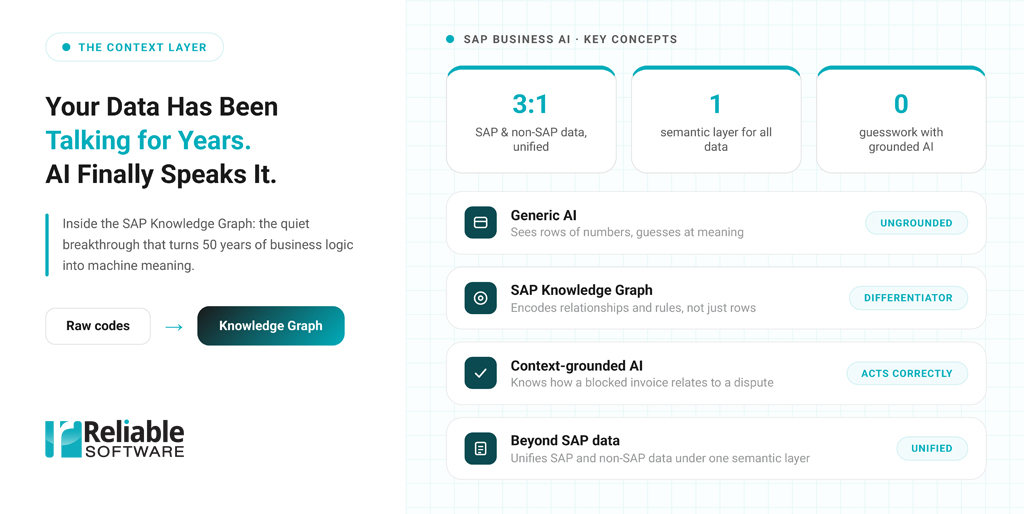
Your Data Has Been Talking for Years. AI Finally Speaks the Language.
Inside the SAP Knowledge Graph, the quiet breakthrough that turns five decades of business logic into something machines can reason with.
Here's an uncomfortable truth about most enterprise AI projects: the model was never the problem. The problem was that the AI had no idea what your data meant.
A column labeled "DOC_TYPE." A table joined to six others. A field that means "credit memo" in finance but something subtly different in sales. To a human expert, these carry decades of meaning. To a raw AI model, they're noise. That gap, between data and meaning, is where most AI initiatives quietly die.
From rows and tables to relationships
The context layer of the SAP Business AI Platform exists to close that gap, and at its heart sits the SAP Knowledge Graph. Think of it as a map of how everything in your business actually connects: a purchase order to a supplier to a payment to a general-ledger entry to a delivery. Not just the data, but the relationships and rules that govern it.
SAP describes it as encoding fifty years of ERP engineering into machine-readable semantic relationships. In plainer terms: the institutional knowledge that used to live only in your most experienced people is now something the AI can read.
Generic AI
Sees a table of numbers. Guesses at meaning. Confidently wrong on the edge cases that matter most.
Context-grounded AI
Knows a blocked invoice relates to a delivery dispute relates to a specific supplier term. Acts correctly.
Why grounding beats raw horsepower
There's a popular myth that the smartest model wins. In the enterprise, the best-grounded model wins. An AI that understands your processes can answer "why is this payment stuck?" by tracing the actual chain of events. An ungrounded one can only produce a plausible-sounding paragraph.
What it unlocks for non-SAP data too
Critically, the context layer doesn't stop at SAP. It unifies SAP and non-SAP data under that same semantic umbrella, so the spreadsheet from a department, the feed from a logistics partner, and your core ERP can finally be reasoned about together. For leaders, this is the difference between AI that works in a demo and AI that works across the messy reality of your actual landscape.
The leadership takeaway
Before you invest another dollar in enterprise AI, ask one question: does it understand our business, or is it just clever? The knowledge graph is what makes the difference durable. It's also why "rip and replace with a generic AI tool" so rarely pays off — you'd be throwing away the very context that makes the AI trustworthy.
Meaning is the moat. And for the first time, it's something you can hand directly to a machine.
helps enterprises build that foundation on SAP, getting your data and business semantics ready so Business AI can be trusted to act.
Is your data ready to be understood by AI?
RSRIT helps enterprises build the data foundation and semantics that make Business AI reliable.
info@rsrit.com